Category Archives: Renovations and Gardening

This category covers such topics as making your home beautiful – inside and out.

Grill on wheels

Grill on wheels

Grill on wheels

Grill on wheels – if you Google these words, you’ll probably end up seeing some hotted up cars with big fat “grills” and massive shiny rims. If that’s what you were looking for, then I congratulate you.

On the other hand, if you were looking for something to roast meat on, that has a certain level of mobility then you probably ended up here.

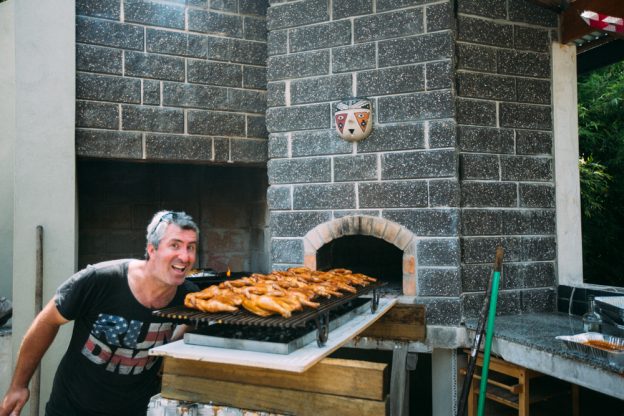
The grill on wheels was an idea that came to me after I made a grill for the WFO that I used for roasting a pig in the WFO. When I pushed the grill into the oven, it scratched the surface of the bricks and made my teeth grind at the same time. So I came up with this simple idea to easily insert and extract the grill from the wood fired oven.

The wheels are made from solid steel flat bar that I cut into squares, then transformed into circles. They are attached to the grill by bolts that were welded to the grill’s ‘feet’. If you have mild steel square bar (10mm x 10mm), some flat 10mm x 75mm bar and 4 M10 nuts and bolts (and know how to weld), then the grill on wheels concept is quite easy to put together. Here are some photos showing the build process  and then the grill on wheels put into action. I certainly hope you enjoy these, as much as I enjoyed eating the Peruvian charcoal chicken that came out of the oven!

Propagating Gracilis Bamboo by Division – 102

Propagating Gracilis Bamboo by Division – 102

Propagating Gracilis bamboo by division is much, much easier than from cuttings. I’ve had mixed results with bamboo propagation via cuttings, but one thing is for sure, the technique outlined below is fool-proof.

Here are a few guidelines that have worked for me that I’d like to share with you.

1) Larger bamboo culms do not work as well as smaller ones. I use Gracilis culms that have the diameter of a pencil.
2) Make sure the culm has a few nodes (3 or more is good).
3) When you dig up the culms, make sure the rhyzome and roots are still attached.
4) In the photos below, I have two culms and a new shoot growing off the rhyzome.
5) Keep the rhyzome wet and work quickly. Don’t leave it out in the sun to dry out.
6) Cut the culm where it is attached to the parent rhyzome, but make sure it has roots attached!
7)  Water new plant in and keep the soil damp (but not water logged)

Progpagating Gracilis bamboo by division is quite straight forward and easy, Just be careful and gentle with the fragile young culms.

I’ll update this post with more photos as the new culms grow. These were taken on the weekend of the 25th of January 2015.

How to make homemade grape juice

How to make homemade grape juice

How to make homemade grape juice a quick tutorial by Henry Gomez.

The Indian Myna bird has successfully managed to shoot to the top of the list of animal pests introduced in Australia – way past cane toads, rats and stupid neighbours. This year, I had to pick the grapes off my muscat vine earlier than I would have liked to because those birds were gorging themselves on my fruits.

Once I collected the grapes off the vine, I was ready to make Moût. I recall as a child after the grape harvest in Geneva ,they would sell grape juice at La Migros and La Coop, it was great and that is when I may have developed my love for red wine.

Over the last couple of years, I used to pluck each grape individually off the bunch to make juice, but I have since talked to a friend who suggested I try this technique:

The method:

1) Wash all of the grapes thoroughly in a large container or in your kitchen sink. Remove any leaves, twigs and sticks etc…

2) Dry the grapes (only kidding)

3) Place the grapes in a pot with boiling water. I fill the pot approximately 3/4 of the way up – if you use too much water, it’ll boil over and make a jolly good mess.

3) Boil the grapes until they become soft and fall off the stem on their own – this usually takes around 30 minutes. Your kitchen will light up with deliciously sweet fragrances…

4) Place the grapes in a colander and squash them till you only have seeds, skins and stems left – make sure you place a container under the colander to catch the grape juice!

5) Repeat this step a couple of times with the colander, and then again with a strainer.

6) You can put the juice in a jug or storage container like a used Coke bottle and add sugar to taste.

This juice can be placed in the fridge once it has cooled down. It is a refreshing beverage in the morning, full of vitamins and anti-oxidants. The only downside is there is no alcohol content.

:(

Check out the deep, dark purple colour. It reminds of a bottle of Grenache I shared with Michel Blanc at Chateau-Neuf-du=Pape in 2007, or was it 2006??

Gardeners of the world unite…

Plantswap is here!

The new plantswap.com.au website is finally here for all you gardeners to enjoy! The concept is quite simple, you join by registering  your free user account and start posting in forums. Imagine you’d just cleaned out your garden, and have a bunch of plants you are about to take to the tip, but instead you’ve put a post on plantswap… Imagine the joy that another plant lover would see the post and contact you by email and he/she organises to come over to take the plants away for you – that’s pretty awesome right?! It’s a win-win situation. In other instances, you may even be able to get some free help – for example if you have a bamboo grove you no longer like and you put an ad on plantswap.com.au asking for people to come over and dig up the bamboo and take it home for free. That’s another win-win situation.

Obviously the site is moderated for people looking for marijuana and other such “exotic” and illegal plants.

I came up with this idea since my wife has been looking for a banana plantain sucker to use in our cooking. This plant is quite popular in South East Asia and Latin America. I am aware that there are plantain trees in Australia but have not been able to find one. Does anyone have one they would like to part with? I have a bunch of plants I could swap you for it!

Propagating Gracilis Bamboo – 101

Dear reader, if you are after detailed instructions on how to successfully propagate Gracilis bamboo from cuttings, this is the link you are after: How to successfully propagate Gracilis bamboo from cuttings as I have managed to grow new Gracilis from cuttings after numerous trials. The instructions in this page were not that good and the rate of success was none.

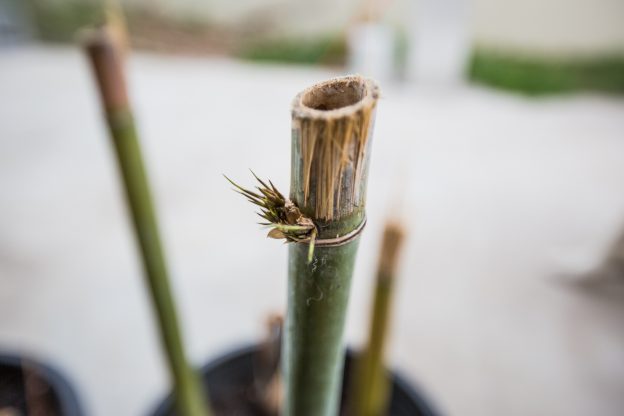
I have finally managed to successfully propagate my very own Bambusa Textilis var. Gracilis! I obtained some culms from a friend and I now have some leaves that have started to bud and very tiny root systems.

It is only fair that I share my findings, but I have to give a lot of credit to Shawn Gilbert who was absolutely instrumental in providing the key points to a successful propagation.

I have currently got a 40% success rate – but this was my first attempt using Shawn’s technique and I have to confirm it works! I am still a little unsure about the exact science as this bamboo has proven to be a difficult plant to propagate. I should also say I didn’t use root hormone (I was too busy cutting the bamboo like mad)

Here are the important points to note:

  • When you first cut the culms, put them in a bucket full of some type of richgrow liquid formula. I used “Seasol” diluted in water and soaked the culms for 2 to 3 hours (it is a seaweed fertiliser rich in nitrogen – grass loves nitrogen)
  • You must use old culms, the older the better
  • Try to find culms with a diameter larger than 1″
  • I found culms with large buttons at the nodes had a better success rate than nodes with no buttons (this is for the 2 node cuttings)
  • Water the culms every day (ensure that you fill the culm with water) for the first month and a half
  • Pick the right time… I planted my culms in the middle of May (Southern Hemisphere = winter)

I have searched the internet for bamboo propagation via culm cuttings and identified two types of cuts that can be used. One cut has 2 nodes, and the other cut only has 1 node and all of the branches coming out of the node have been cut back – all except for the main one (as per Shawn’s website).
It took 2 weeks for the first leaves to appear, but at the 1 month mark, tiny branches were popping out of the buttons at the nodes .

Single node cutting - new leaf is sprouting

Single node cutting – new leaf is sprouting (1 month mark)

Two nodes cutting

Two node cuttings – 1 month mark

Single branch at a single node

Single branch at a single node cutting – 1 month mark

More  branches popping out

More branches popping out

Small button at a node - ready to pop out

Small button at a node – ready to pop out (2 months mark)

Single node cutting with one branch. See the new leaf?

Single node cutting with one branch. See the new leaf?

Double node with branches appearing

Double node with branches appearing – 2 month mark

More double node cuttings

More double node cuttings

Few bamboo cuttings in one pot

Few bamboo cuttings in one pot

I also noticed the culms that stayed green after the 1.5 month mark would be successful as they had leaves pop out soon after.

We are now getting to the 2 month mark and I pulled one of the culms out to see if it had roots. The photos below show a thin, long and stringy roots.

Single node bamboo - no roots at the branch

Notice how the culm is still green even after 2 months in the ground?

Bud appearing at the on the single branch

Bud appearing on the single branch – note: there are no roots at single node.

I am going to leave the culms in the pots a couple of months longer and wait for spring to swing by.

Update: 19th May 2016 – these cuttings all dried and died after months of watering.

But this page: How to successfully propagate Gracilis bamboo from cuttings has instructions that actually worked!